Adaptive Immunity
The precision weapon of the immune system — slower to activate but incredibly specific, with the remarkable ability to remember every pathogen it has ever encountered.
Humoral & Cell-Mediated
Adaptive immunity operates through two complementary branches, each specialized for different types of threats.
Humoral (Antibody-Mediated) Immunity
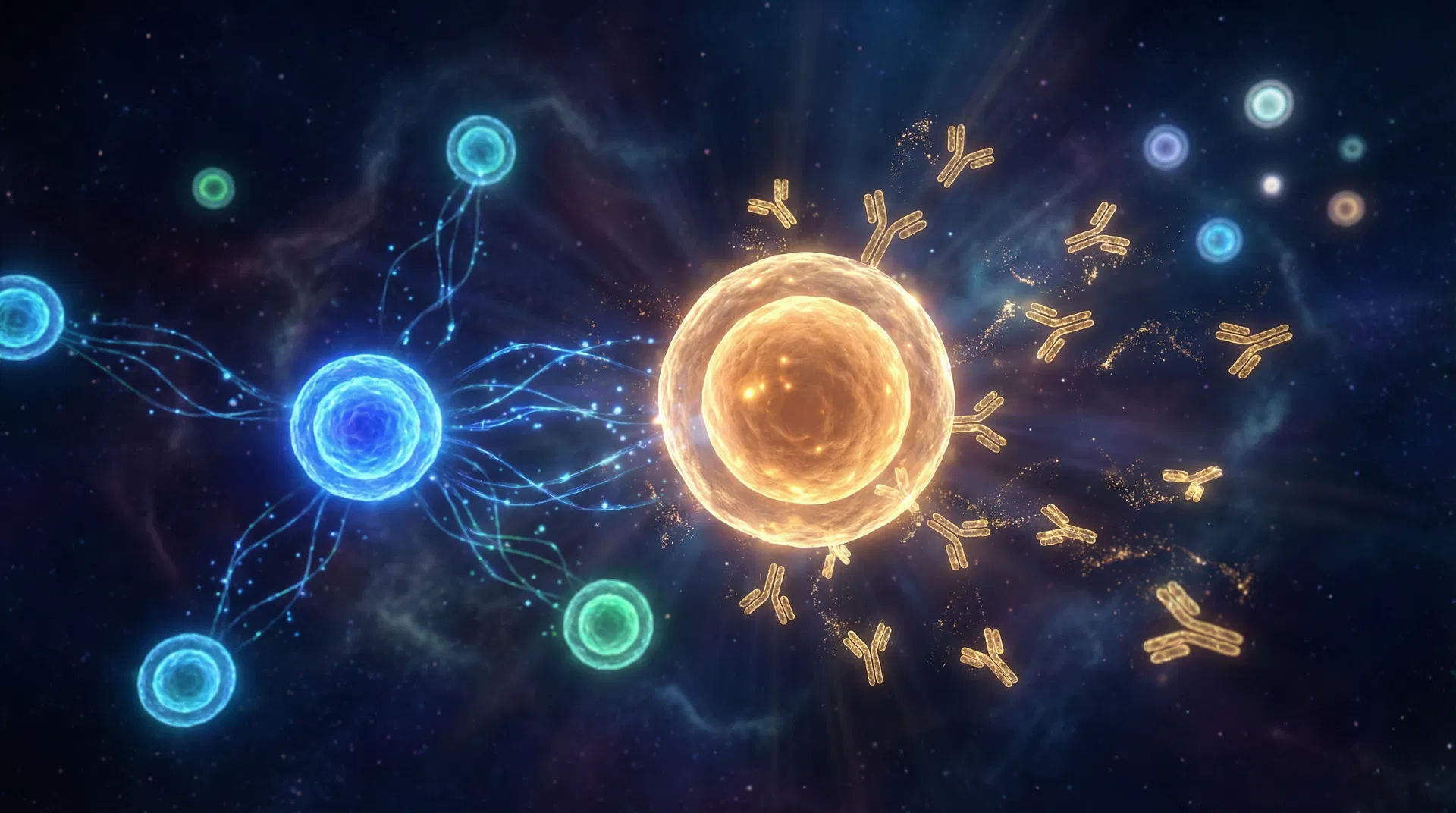
B lymphocytes produce antibodies (immunoglobulins) that circulate in blood and lymph to neutralize extracellular pathogens.
B Cell Activation
B cells bind antigens via their B-cell receptor (BCR). With T helper cell co-stimulation, they proliferate and differentiate.
Plasma Cells
Activated B cells become plasma cells that secrete up to 2,000 antibody molecules per second.
Antibody Classes
IgG (most abundant, crosses placenta), IgA (mucosal surfaces), IgM (first responder), IgE (parasites/allergies), IgD (B cell activation).
Neutralization
Antibodies bind to pathogen surface proteins, blocking their ability to infect host cells.
Opsonization
Antibody-coated pathogens are more easily recognized and engulfed by phagocytes.
Memory B Cells
Long-lived cells that persist for decades, enabling rapid secondary response upon re-exposure.
Antibody Architecture
Antibodies are Y-shaped glycoproteins (immunoglobulins) with a modular design optimized for antigen recognition and immune activation.
Heavy Chains
Two identical heavy chains form the core structure and determine the antibody class (IgG, IgA, IgM, IgE, IgD).
Light Chains
Two identical light chains (kappa or lambda) pair with heavy chains to form the antigen-binding sites.
Variable Region (Fab)
The tips of the Y-shape contain hypervariable regions that bind specifically to one epitope on an antigen.
Constant Region (Fc)
The stem of the Y-shape interacts with immune cells and complement proteins to trigger effector functions.
Hinge Region
Flexible region allowing the two Fab arms to move independently, enabling binding to multiple epitopes.
Key Engineering Analogy
Adaptive immunity works like a version control system with machine learning. Each encounter with a pathogen is like training data — the system generates specific "classifiers" (antibodies/T-cell receptors) and stores successful configurations in "memory branches" (memory cells).
On re-exposure, the system doesn't start from scratch. It performs a "hot reload" from memory, producing a faster and stronger response. This is the fundamental principle behind vaccination — providing training data without the risk of actual infection.