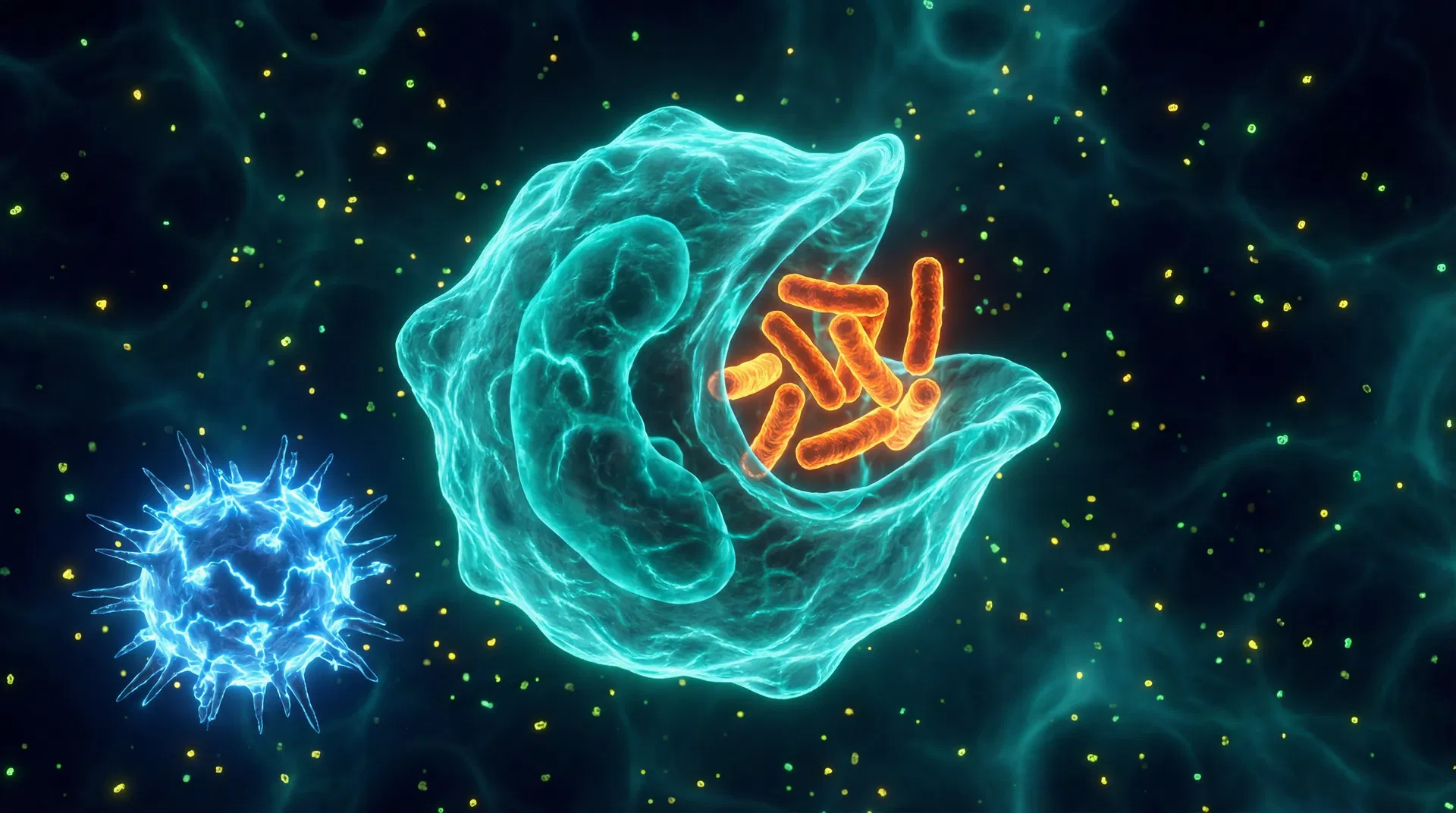
Innate Immunity
The body's rapid-response defense system — always on guard, always ready. Non-specific but incredibly fast, it buys time for the adaptive immune system to mount a targeted response.
Key Mechanisms
The innate immune system employs multiple strategies to detect and eliminate pathogens without prior exposure.
Phagocytosis
Macrophages and neutrophils engulf and digest pathogens. Macrophages can consume up to 100 bacteria before dying. This process also presents antigens to activate adaptive immunity.
Inflammation
Damaged cells release histamine and cytokines, causing blood vessels to dilate and become permeable. This recruits more immune cells to the site of infection — causing redness, heat, swelling, and pain.
Complement System
A cascade of ~30 proteins that can directly lyse pathogens via the Membrane Attack Complex (MAC), opsonize them for phagocytosis, or trigger inflammation through anaphylatoxins.
Pattern Recognition
Toll-like receptors (TLRs) and other PRRs detect conserved molecular patterns (PAMPs) on pathogens — such as lipopolysaccharide (LPS) on bacteria or double-stranded RNA in viruses.
Natural Killer Cells
NK cells patrol the body and kill virus-infected or cancerous cells that display reduced MHC class I molecules. They use perforin and granzymes to induce apoptosis in target cells.
Physical Barriers
Skin provides a waterproof barrier with antimicrobial peptides (defensins). Mucous membranes trap pathogens. Cilia in airways sweep debris upward. Stomach acid (pH 1.5–3.5) kills most ingested microbes.
Innate Response Timeline
From the moment a pathogen breaches the skin, the innate immune system launches a coordinated cascade of events.
Pathogen breaches surface barrier
Bacteria enter through a wound in the skin
Mast cells release histamine
Local blood vessels dilate, increasing blood flow
Neutrophils arrive
First phagocytes reach the infection site via chemotaxis
Macrophages activated
Tissue-resident macrophages begin phagocytosis and cytokine release
Complement cascade activated
Complement proteins opsonize pathogens and form MAC
Dendritic cells migrate
Antigen-presenting cells travel to lymph nodes to activate adaptive immunity
Key Engineering Analogy
Think of innate immunity as a firewall in a computer network. It applies predefined rules (pattern recognition) to filter out known types of threats immediately, without needing to analyze each packet individually. It cannot learn from new attacks, but it provides essential baseline protection.
The adaptive immune system, by contrast, is like a machine learning-based intrusion detection system — it takes longer to train, but once it learns a threat signature, it can detect and respond to it with remarkable precision and speed.