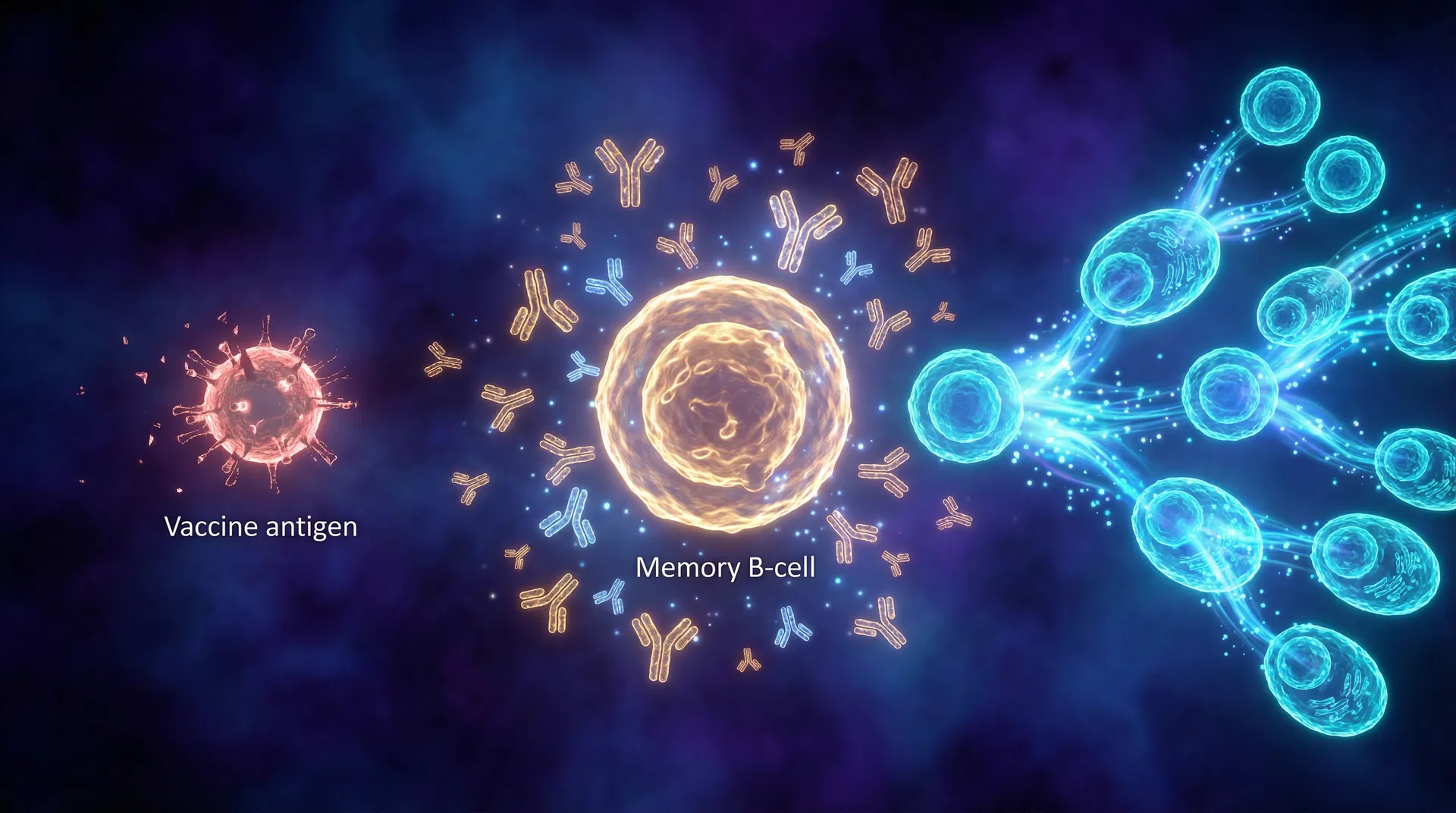
Vaccination & Memory
How vaccines harness immunological memory to provide protection without disease — one of the greatest achievements in medical history.
How Vaccines Work
Vaccines introduce a harmless form of a pathogen (or its components) to train the adaptive immune system, creating memory cells without causing disease.
1. Antigen Introduction
The vaccine delivers antigens (weakened pathogen, protein subunit, or mRNA instructions) to the body, mimicking a natural infection.
2. Immune Activation
Dendritic cells capture antigens and present them to T and B cells in lymph nodes. Helper T cells coordinate the response, B cells produce antibodies.
3. Memory Formation
After clearing the antigen, long-lived memory T and B cells persist. Upon re-exposure to the real pathogen, they mount a rapid, powerful response.
Primary vs. Secondary Response
Primary Response
First exposure to antigen. Slow antibody production, mainly IgM. Naive B and T cells must be activated and undergo clonal expansion.
Secondary Response
Re-exposure to same antigen. Rapid, massive antibody production, mainly IgG. Memory cells are quickly reactivated.
Types of Vaccines
Different vaccine technologies use different strategies to present antigens to the immune system.
| Type | Examples | Pros | Cons |
|---|---|---|---|
| Live Attenuated | MMR, Varicella, Yellow Fever | Strong, long-lasting immunity; often single dose sufficient | Not suitable for immunocompromised; requires cold storage |
| Inactivated | Influenza (shot), Hepatitis A, Polio (IPV) | Safe for immunocompromised; stable storage | Weaker immune response; often requires boosters |
| Subunit / Recombinant | Hepatitis B, HPV, Pertussis (acellular) | Very safe; targeted immune response | May need adjuvants; multiple doses often required |
| mRNA | COVID-19 (Pfizer, Moderna) | Rapid development; strong humoral and cellular response | Requires ultra-cold storage; relatively new technology |
| Viral Vector | COVID-19 (AstraZeneca, J&J), Ebola | Strong immune response; single dose possible | Pre-existing immunity to vector may reduce efficacy |
| Toxoid | Tetanus, Diphtheria | Targets the disease mechanism directly | Only effective against toxin-producing pathogens; needs boosters |